The Mayan calendar is one of the most fascinating and complex timekeeping systems in human history. Created by the ancient Maya civilization of Mesoamerica, this calendar was not only a tool for tracking days and seasons—it was also deeply connected to astronomy, religion, and cosmic cycles.
To understand how the Mayan calendar works, we need to explore its intricate structure of days, months, and cycles that reflect how the Maya viewed time as an ongoing, living rhythm rather than a linear sequence.
Overview: The Purpose of the Mayan Calendar
For the Maya, time was sacred. Their calendar was more than a schedule—it was a reflection of their cosmology and connection to the universe.
The Mayan calendar served three main purposes:
- Agricultural: To plan planting, harvesting, and seasonal festivals.
- Religious: To align rituals with cosmic energies and deities.
- Astronomical: To track celestial events like solstices, equinoxes, and planetary cycles.
The Three Main Systems of the Mayan Calendar
The Maya used three interrelated calendars that worked together to measure time:
The Tzolk’in – The Sacred Calendar (260 Days)
The Tzolk’in was a 260-day calendar used for spiritual and ceremonial purposes. It consisted of:
- 20 day names (glyphs)
- 13 numbers
Each day combined one number and one day name, creating 260 unique day combinations before repeating.
Example of day names:
Imix, Ik’, Ak’bal, K’an, Chicchan, Cimi, Manik’, Lamat, Muluk, Ok, Chuen, Eb, Ben, Ix, Men, Cib, Caban, Etz’nab, Cauac, and Ahau.
Each day carried symbolic meaning and was believed to influence personal destiny and cosmic energy.
The Haab’ – The Solar Calendar (365 Days)
The Haab’ functioned more like our modern solar calendar. It had:
18 months of 20 days each = 360 days
Plus a short 5-day period called Wayeb’, considered an unlucky or transitional time
The 18 months were:
Pop, Wo, Sip, Sotz’, Sek, Xul, Yaxk’in, Mol, Chen, Yax, Sak’, Keh, Mak, K’ank’in, Muwan, Pax, Kayab, and Kumk’u.
The Wayeb’ period (the last 5 days of the year) was thought to be a time when the boundaries between the mortal and spiritual worlds blurred, requiring extra caution and rituals.
The Calendar Round – The 52-Year Cycle
The Calendar Round combined the Tzolk’in (260 days) and the Haab’ (365 days). It took 52 Haab’ years—about 18,980 days—for the two calendars to realign.
This 52-year period was extremely important to the Maya. It symbolized a cycle of renewal, marking the end of one age and the beginning of another. When a Calendar Round ended, communities performed ceremonies to ensure the continuation of the world and the favor of the gods.
The Long Count – Measuring Cosmic Time
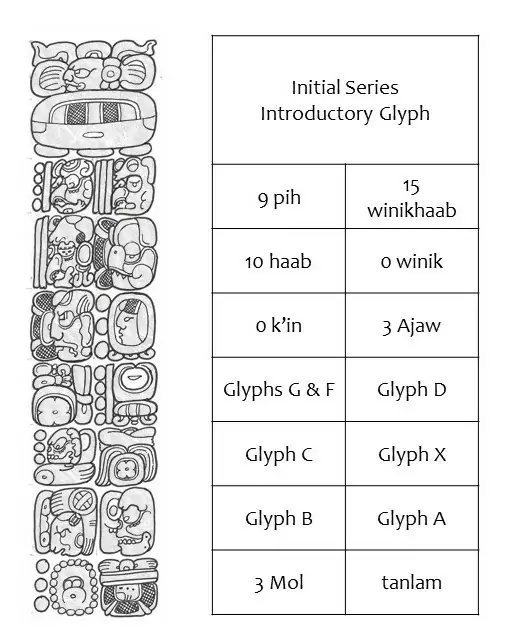
Beyond the Calendar Round, the Maya tracked even longer periods using the Long Count, which recorded days from a mythological starting point—believed to be August 11, 3114 BCE (in the Gregorian calendar).
The Long Count uses a base-20 and base-18 numbering system:
| Unit | Value (in days) | Approx. Equivalent |
|---|---|---|
| 1 Kin | 1 day | 1 day |
| 1 Uinal | 20 Kin | 20 days |
| 1 Tun | 18 Uinal | 360 days (approx. 1 year) |
| 1 K’atun | 20 Tun | 7,200 days (~19.7 years) |
| 1 Bak’tun | 20 K’atun | 144,000 days (~394 years) |
The famous “2012 Mayan prophecy” referred to the completion of a 13th Bak’tun, which the ancient Maya saw as the end of one cosmic cycle and the beginning of another—not the end of the world.
The Mayan View of Time: Cyclical, Not Linear
Unlike the modern Gregorian calendar, which views time as a straight line, the Maya believed time was cyclical.
- Each day, month, and cycle carried specific energies and deities.
- Time wasn’t simply passing—it was repeating and renewing itself.
- The completion of a cycle was a moment of rebirth, not an ending.
This concept shaped their rituals, architecture (like the alignment of pyramids with solstices), and even politics, as rulers timed major events to align with auspicious days.
How the Mayan Calendar Connects to Astronomy
The Mayan priests (known as day keepers) observed the movements of celestial bodies to align their calendars precisely.
- They tracked the sun’s solstices and equinoxes.
- They monitored the Venus cycle, which lasted 584 days.
- They built temples, such as El Castillo at Chichén Itzá, that functioned as astronomical observatories—casting shadow patterns that marked seasonal transitions.
Their astronomical precision rivals that of modern calculations, reflecting how deeply the Maya integrated science and spirituality.
What We Can Learn from the Mayan Calendar
Modern people can take inspiration from the Mayan approach to time:
- Live in rhythm with nature: Recognize the cycles of light, seasons, and personal growth.
- Value reflection: Each ending marks a chance to begin anew.
- Balance logic and spirituality: Use planning tools but remain aware of larger cosmic patterns.
The Mayan calendar reminds us that time isn’t just about schedules—it’s about our connection to the universe and the cycles of life.
FAQ: How the Mayan Calendar Works
- How many calendars did the Maya use?
The Maya used three: the 260-day Tzolk’in, the 365-day Haab’, and the Long Count for historical dating. - What’s the difference between the Tzolk’in and the Haab’?
The Tzolk’in tracked spiritual and ritual cycles, while the Haab’ tracked the solar year and agricultural seasons. - Did the Mayan calendar predict the end of the world in 2012?
No. It marked the end of one Bak’tun (a long cycle) and the beginning of another—a moment of cosmic renewal. - Why was the number 52 important?
It took 52 Haab’ years for the Tzolk’in and Haab’ calendars to realign, symbolizing a full cycle of time. - Are Mayan calendar dates still used today?
Yes. In parts of Guatemala and southern Mexico, traditional day keepers still observe the Tzolk’in for rituals and cultural events.
The Mayan calendar represents one of the most advanced systems of timekeeping ever created—blending mathematics, astronomy, and spirituality into a unified view of the cosmos.
By understanding its days, months, and cosmic cycles, we gain insight into how the Maya perceived life—not as a straight line, but as an eternal rhythm of renewal. The legacy of their calendar continues to inspire curiosity and respect for the deep connection between time, nature, and human consciousness.